
How to Switch Commercial Property Managers Without Tenant Chaos
“I’ll lose tenants or everything will break during the transition.” If you’re a commercial property owner in Sacramento or nearby cities like Roseville, Elk Grove, or Folsom, this fear may sound familiar. The good news is that switching property management companies doesn’t have to be chaotic. With careful planning and communication, you can change commercial property managers smoothly – without losing tenants or disrupting operations. This comprehensive guide provides a step-by-step transition checklist, a 30–60 day timeline, and communication templates to ensure your tenant relationships and property performance stay protected throughout the switch.
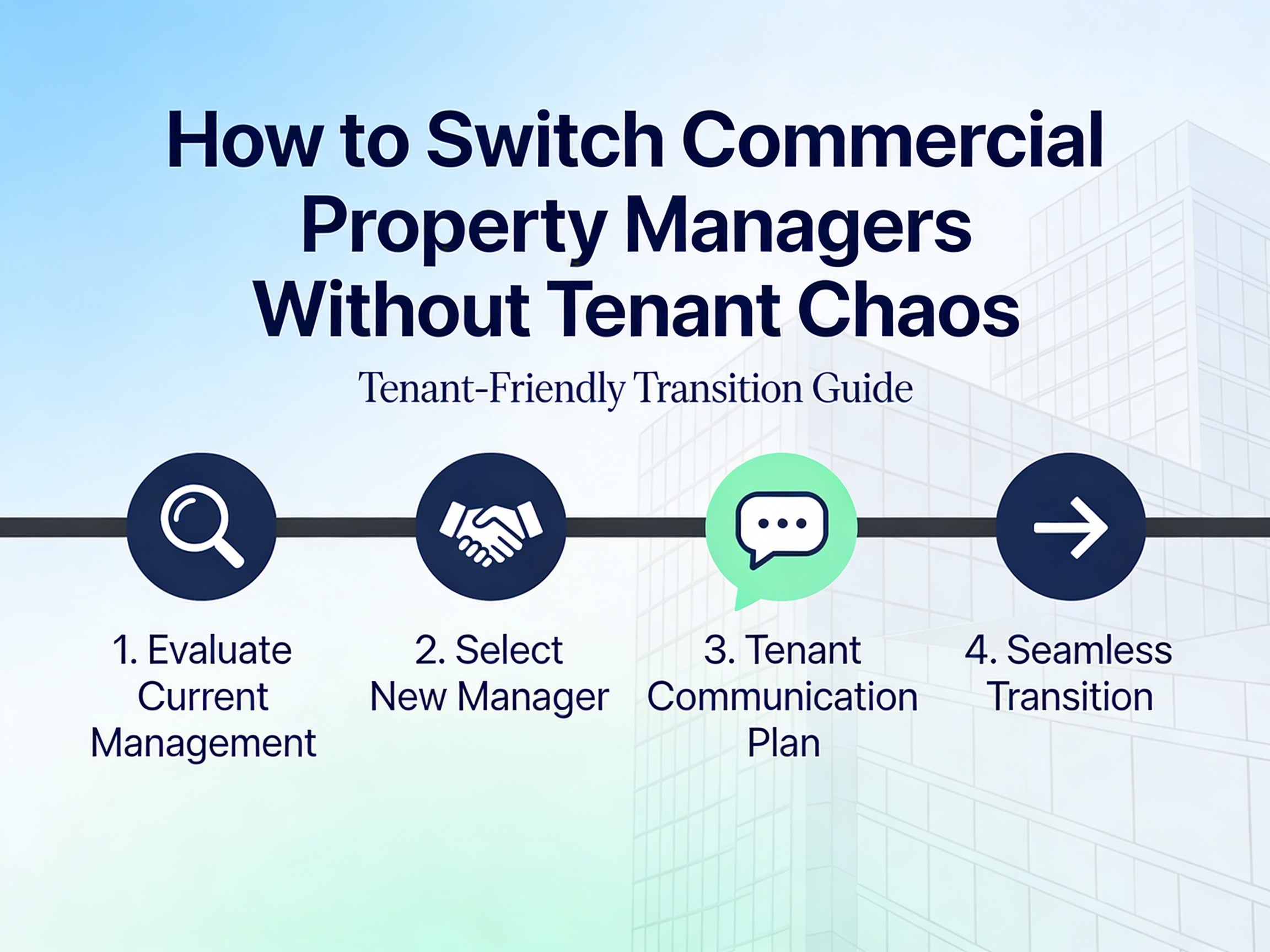
Transition Checklist: Key Categories for a Smooth Switch
Organize your transition into clear categories. Below is a checklist broken down by the essential areas you should cover when changing commercial property managers:
✅Documents & Records to Gather:
Lease Agreements & Tenant Files: Obtain copies of all current leases, amendments, and tenant contact information. These documents ensure the new manager understands every tenant’s terms and obligations.
Financial Records: Gather recent rent rolls, income/expense statements, budgets, and CAM (Common Area Maintenance) reconciliation reports. The outgoing manager should provide final account reconciliations for security deposits, reserves, and any operating funds.
Maintenance & Inspection Records: Collect maintenance logs, open work orders, past inspection reports, warranties, and building plans. This history helps the new manager anticipate property needs and avoid anything “breaking” unexpectedly during the handover.
Service Contracts & Legal Documents: Compile all vendor contracts (e.g. for HVAC, landscaping, cleaning, security) and any compliance documents or certificates. Ensure every contract and warranty is accounted for. Having these on hand prevents lapses in service and keeps the property in legal compliance from day one.
✅Vendor Contacts & Contracts:
Vendor Contact List: Make a list of all your property’s vendors and service providers (maintenance contractors, cleaning crews, landscapers, security companies, etc.), including contact names, phone numbers, and email addresses. The new manager will use this to notify each vendor of the change in management.
Contract Details: Share copies of vendor agreements with the new manager. Note key details like service schedules, contract end dates, and payment terms. This ensures the incoming team knows the scope of each vendor’s work and any obligations in place.
Notify & Introduce: Inform all vendors about the management switch before it happens. Ensure vendors are officially notified of the transition and provided with the new manager’s contact and billing information. A simple introduction email or letter (see template below) prevents confusion, so vendors continue their services without interruption.
Review Contracts: Take the opportunity to review if current vendors still fit your needs. The new manager can help assess whether to retain or rebid certain services after the transition. However, in the short term, make it clear that all existing service terms will be honored during the handover to keep operations running smoothly.
✅Tenant Communication & Notices:
Early & Clear Notices: Proactive communication with tenants is crucial to avoid panic or rumors. Plan to send a formal transition notice to all tenants well in advance, typically 30–60 days before the management change. (Many states, including California, legally require at least 30 days notice of a management change.) In the notice, introduce the new management company and reassure tenants that their leases, rent terms, and services will remain unchanged during the switch.
Key Information for Tenants: Your tenant notice should highlight: the effective date of the management change, new contact information for rent payments and maintenance requests, and instructions for any new rent payment process (such as a different online portal or mailing address). Emphasize that the tenant’s obligations and rights stay the same – for example, confirm that rent amounts and due dates do not change and that all lease terms will continue to be enforced. This helps dispel tenant worries about the unknown.
Multiple Touchpoints: Don’t rely on a single letter. Follow up with reminder communications as the transition date approaches. For instance, you might send an initial announcement 60 days out, a reminder at 30 days, and a final update two weeks before the switchover. Repeating the message ensures every tenant is aware and prepared, greatly reducing confusion on Day One of the new management.
Dedicated Contact for Questions: Assign a point person (either someone from the new management team or an owner representative) to handle any tenant inquiries during the transition. Tenants should know exactly who to call or email if they have questions about rent, repairs, or any issue during the changeover. Promptly addressing tenant concerns will maintain trust and confidence, so they don’t feel “lost in the shuffle” of the management change.
✅Rent Collection & Financial Logistics:
Timing of Transition (Rent Cycle): Plan the official handover date with rent collection in mind. It’s wise not to switch managers on the first of the month or right when rent is due. Instead, aim for a date just after the rent cycle (for example, right after grace period ends). One expert suggests: if rent is due on the 1st (with a grace period until the 7th), start the new management on the 8th – this gives a few weeks before the next rent cycle to sort out payments and notices. By avoiding the rent rush, you prevent misrouted payments or confusion over where rent goes.
Payment Methods & Accounts: Set up the new property manager with the necessary financial accounts well in advance. This includes bank accounts or online payment portals for collecting rent, and confirming how tenants should pay going forward. If the payment procedure is changing (new online system or mailing address), inform tenants clearly in writing and in person if possible. Ensure the outgoing manager stops accepting payments as of the switchover date, so nothing falls through the cracks.
Security Deposits & Trust Funds: Coordinate the transfer of all security deposits and reserve funds to the new manager’s trust account on the effective date. Have the outgoing manager provide a full accounting of tenant deposits and any prepaid rents. The tenants should be informed that their deposits are now held by the new company under the same terms – this transparency prevents any concerns about deposit safety.
Final Reconciliations & Handover of Funds: As part of the transition, the outgoing management company should reconcile all finances up to the handover date. This includes prorating any rents collected, paying outstanding invoices, and settling management fees. Owners should review these final statements and confirm all obligations are met before releasing any final termination fees to the old manager. Once everything is accounted for, the new manager can take over the books with a clear starting balance and no loose ends.
By addressing each of these categories, you tackle the biggest pain points that could otherwise lead to “tenant chaos.” In short: gather your documents, align your vendors, communicate with tenants, and button up the finances. Now, let’s map these steps onto a timeline to see how a smooth transition unfolds.
Recommended 30–60 Day Transition Timeline
Switching commercial property managers is not an overnight task. A 30–60 day timeline is typically recommended to cover all the bases (larger commercial properties may take up to 90 days for a full transition). Below is a sample timeline with key milestones to ensure a seamless handover:
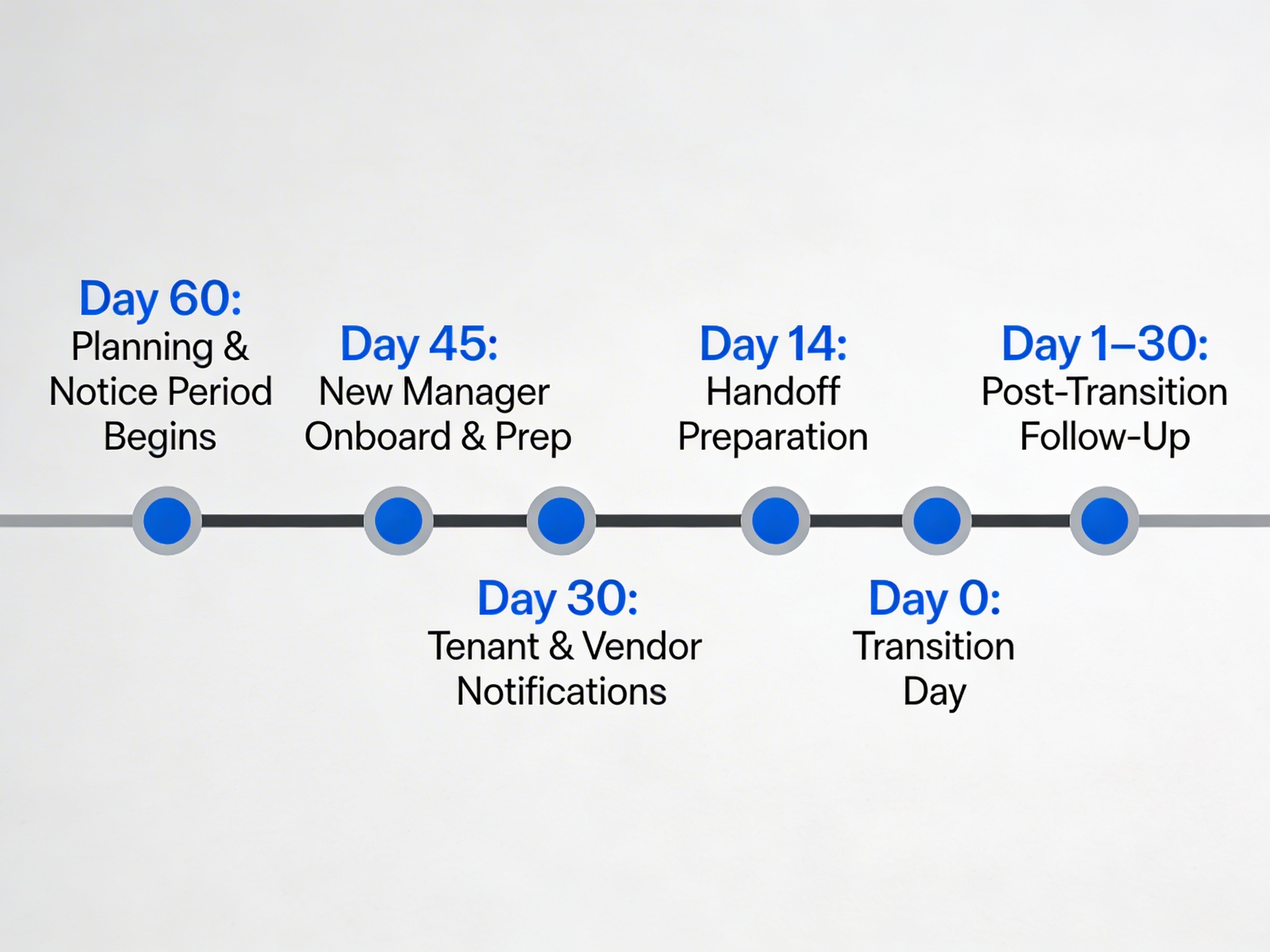
Day 60 (Planning & Notice Period Begins): Review your current management contract for termination notice requirements and any transition clauses. Many contracts ask for a 60-day notice, which is an ideal lead time. Once you’ve selected your new property manager, officially notify your current management company in writing that you intend to terminate services. Around this time, informally let your major tenants know a change is coming soon (you will send formal notices later). Also begin assembling all important documents (leases, contracts, financials) so they can be easily transferred.
Day 45 (New Manager Onboard & Prep): By roughly six weeks out, have your new property management company fully engaged in transition planning. Share the collected documents with them and review the property’s current operations together. This is a great time for the new manager to tour the property and meet any on-site staff. Start drafting the tenant transition letter and have the new manager contribute contact info and branding to it. If your region or property type requires any specific legal notices to tenants or authorities, prepare those now (for example, in California, notify tax authorities or licensing boards if needed).
Day 30 (Tenant & Vendor Notifications): Send the formal transition notice to all tenants about 30 days before the handoff date. (Include the key details: effective date, new manager contact info, rent payment instructions, and assurances of continuity.) Around this time, also have the new manager or owner reach out to each vendor. Provide vendors with the new management’s contact and billing details, and confirm service schedules during the change. With one month to go, both managers (outgoing and incoming) should coordinate on open issues: e.g. ensure the outgoing manager is finishing any critical repairs or work orders so the new team isn’t left with a mess.
Day 14 (Handoff Preparation): Two weeks before the switch, send a reminder notice to tenants. This can be a shorter communication reiterating the upcoming management change and any actions tenants need to take (such as creating a login on a new rent portal or simply noting the new contact info). Tenants should by now know who their new point of contact is, but a reminder boosts confidence that yes, this is really happening and here’s what to expect. Meanwhile, behind the scenes, ensure all funds and accounts are ready: the new manager’s bank accounts for rent and deposits should be set up, and the outgoing manager should prepare to transfer any tenant money on the switchover date. This is also a good time for the outgoing and incoming managers to schedule a joint property walkthrough to inspect the building together. Document the property condition (take photos) so both parties agree on any existing issues prior to handoff.
Day 0 (Transition Day): Handover day has arrived – typically either the first or last day of a month, or another agreed date when the old manager steps out and the new manager takes over fully. Have someone from the owner’s side (or the new manager) on-site to greet tenants or address any immediate questions. All keys, access codes, and remotes should be exchanged now. The new property manager begins handling all responsibilities effective immediately – from rent collection to maintenance calls. Thanks to your preparation, tenants should notice hardly anything unusual on this day other than the new contact information on the office door or noticeboard. Life at the property goes on as normal, which is exactly the goal.
Day 1–30 (Post-Transition Follow-Up): The first month under new management is a time to follow through and ensure no balls get dropped. The new manager should reach out to any tenants or vendors who haven’t yet engaged – for example, if a tenant hasn’t paid rent through the new system, a friendly reminder may be needed. The owner should receive initial reports to confirm rent was collected and services are continuing smoothly. Encourage the new manager to solicit tenant feedback after a few weeks – do tenants feel the transition was smooth? Are there any complaints or confusion? Promptly address any lingering issues. By maintaining open communication in this early phase, you demonstrate to tenants that the property is in good hands, keeping those relationships strong.
This timeline can be adjusted to fit your specific situation (some owners may have more time to plan, others might need a quicker 30-day change). The key takeaway is to start early and hit these milestones in order, so nothing is rushed last-minute. As one seasoned professional notes, a complete commercial management transition often takes 60–90 days to do properly – but with the right team and checklist, smooth results in 30–60 days are very achievable.
Sample Transition Communication Templates
Clear communication is the secret to preventing tenant chaos. Below are two sample templates you can use during your transition: an owner-to-tenant notice announcing the new management, and a property manager-to-vendor message to ensure vendors stay on board. Feel free to customize these for your property and situation.
Owner-to-Tenant Transition Notice (Sample Letter)
Dear Valued Tenant,
I am writing to inform you that as of [Effective Date], the property located at [Property Address] will be under new management. [New Property Management Company] has been appointed by the ownership to take over day-to-day management of the building. We made this change to enhance our service to you and ensure the property is maintained at the highest level.
What this means for you: Rest assured, your lease terms remain unchanged – your rent amount and due date will stay the same. The policies in your lease (maintenance responsibilities, rules and regulations, etc.) all continue in full effect. Your security deposit is safe and has been transferred to the new management’s trust account, in accordance with your lease and California law.
New contact information: Starting on [Effective Date], please use the following contact details for any needs:
– Rent Payments: [New payment instructions – e.g. mailing address or online portal]. (Rent is still due on the same schedule.)
– Maintenance Requests: [New maintenance request phone number or online system].
– Emergency After-Hours: [Emergency contact number].
– General Inquiries: [New manager’s name, phone, and email].
The previous management will no longer be handling these matters after that date.
Our commitment: We will make every effort to ensure this transition is as seamless as possible for you. All building services (maintenance, security, cleaning) will continue without interruption. The new management team is eager to meet you and deliver excellent service.
If you have any questions or concerns about this change, please do not hesitate to contact [New Manager Contact Name] at [phone/email]. Thank you for your understanding and for being a valued tenant at [Property Name].
Sincerely,
[Owner’s Name]
Owner, [Property Name]
New Property Manager-to-Vendor Introduction (Sample Email)
Subject: Introduction – Managing [Property Name] in [City] as of [Date]
Hello [Vendor Name],
I hope this message finds you well. My name is [Your Name], and I am the new property manager for [Property Name] in [Sacramento/City Name]. I’m reaching out to introduce our company ([New Management Company]) as we will be taking over management of the property from [Outgoing Company] effective [Effective Date].
First, let me say we appreciate the excellent service [Vendor Company] has been providing at [Property Name]. We value our relationship and aim to ensure a seamless transition with no disruption to your services. All existing service schedules and contract terms will remain in place for now – we will honor the current agreement that you have for [describe service, e.g. HVAC maintenance or cleaning].
What we need from you: Please update your records to reflect our contact and billing information for [Property Name]. Going forward, direct all invoices, service reports, or communications to:
– [New Manager Name], Property Manager – Phone: [###-###-####], Email: [manager@[company].com]
– Billing Address: [New Company Billing Address]
We kindly ask that any invoices for work at [Property Name] dated on or after [Effective Date] be made out to [New Management Company]. Also, if there are any pending work orders or scheduled visits around the transition date, let us know so we can coordinate and ensure nothing falls through the cracks.
Next steps: Our team will follow up with a phone call in the next few days to touch base. In the meantime, don’t hesitate to reach out if you have questions or need any information. We are committed to working closely with you and continuing the strong partnership that benefits [Property Name] and its tenants.
Thank you for your attention to this update. We look forward to working with you.
Sincerely,
[Your Name]
Property Manager, [New Management Company]
[Your Phone] | [Your Email]
By using templates like these, you ensure that no one is left in the dark. Tenants feel reassured that their needs will be met, and vendors understand they will get paid and who to contact – heading off the chaos before it can start.
Print this page + Book a Free Consult to get personalized guidance on making a smooth property management transition in the Sacramento area. With a structured plan in hand, you can switch commercial property managers confidently, keep your tenants happy, and protect your investment’s performance. It’s time to turn that “tenant chaos” fear into peace of mind with a well-executed transition plan. Good luck with your smooth switch! If you would like help from our friendly team Sierra Property Management please Call us 916-721-9525 or click here to reach out to connect.
